Selecciona tu idioma
Walk past any restored townhouse and the floor gives the era away before the door does: geometric stars, borders, chessboard entries. Victorian floor tiles turned hallways into welcome mats for a whole civilisation, and a century and a half later the look is back on every renovation board.
In this guide we cover what defines victorian style floor tiles, the encaustic technique behind the originals, where the pattern works today, and how to build the look in porcelain without the fragility of the antiques.
The victorian floor is geometry with manners. Its vocabulary is precise: small squares, triangles, octagons and stars composed into repeating carpets, almost always framed by a decorative border, in a palette of clay reds, ochres, creams, blacks and the occasional blue.
The pattern always had a job to do. Halls announced the house, porches survived the weather, and kitchens hid the wear of service. That practicality is why the style reads as honest rather than ornamental, and why it fits renovation projects so naturally today.
The classic victorian floor was built from encaustic tiles: pieces whose pattern is not painted on the surface but formed by different colours of clay pressed through the body, so the design survives decades of footsteps. Beautiful, and demanding, because the originals are porous, they drink stains, and they ask for waxes and gentle cleaners forever.
Porcelain flips that bargain. Decorated pieces reproduce the encaustic look, patterns, borders and slightly worn textures included, on a body that ignores water, bleach and traffic. The travelling patterns of Fado, inspired by the decorated tiles that sailed between Portugal and the Americas, and the labyrinth JUK designs of Stay are the catalogue’s two doors into that world.
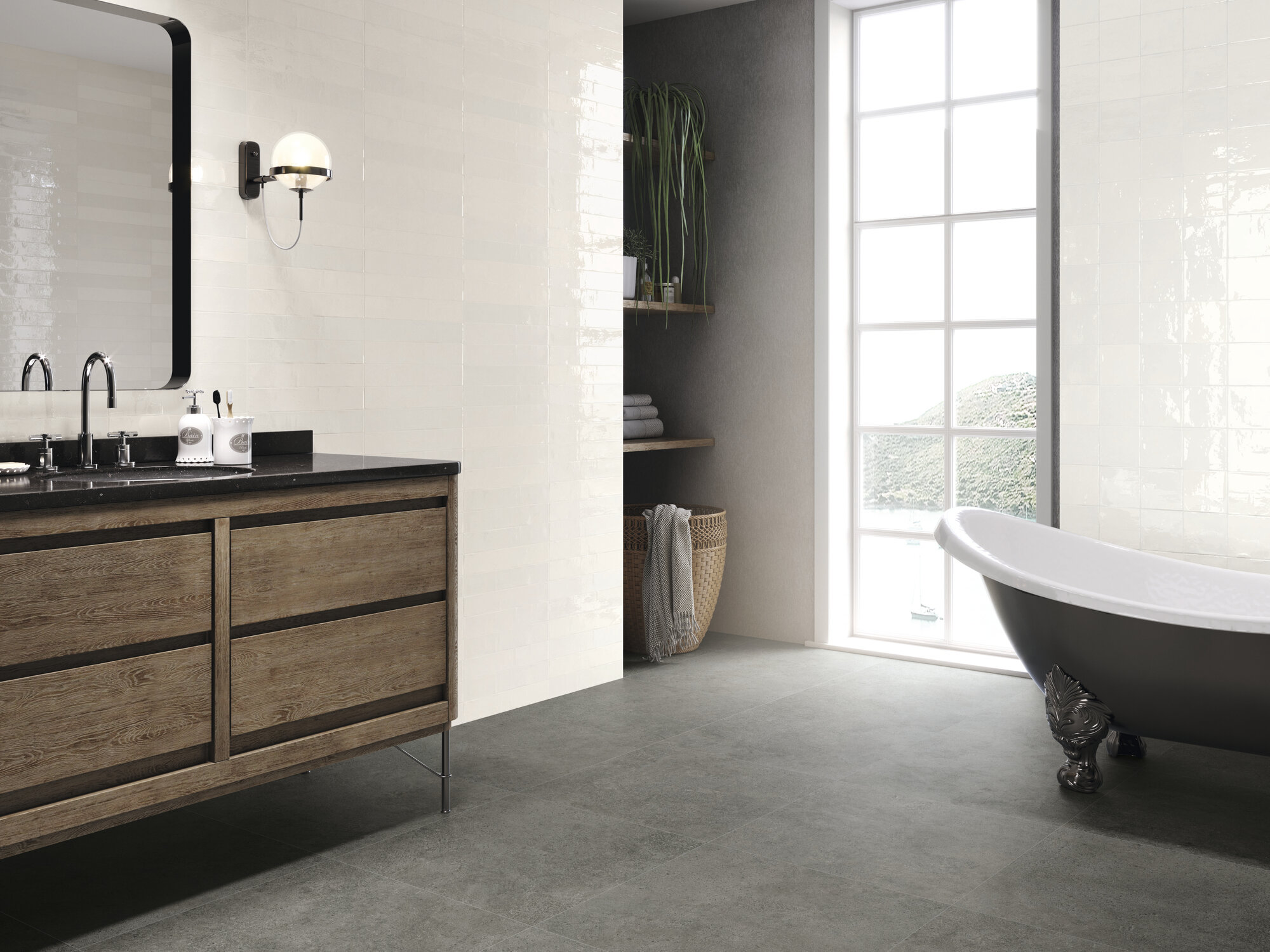
Searches agree: the victorian bathroom is where the era gets rebuilt most often. The formula has three layers. A patterned or dark floor to ground the room. Glazed wainscot walls to shoulder height, white or soft-coloured, with a border piece to finish. And the cast: a clawfoot tub, crosshead taps, a rounded mirror.
If you are furnishing the whole era rather than one room, our guide to vintage bathroom tile walks through the neighbouring decades too.
Three practical rules keep the revival authentic. Keep the scale small: the originals rarely exceeded 15 or 20 centimetres, and the dense grid is part of the charm. Respect the border: a patterned field without its frame reads as wallpaper, not as a victorian floor.
And ground the palette in earth: clay red, ochre, cream and black were the era’s colours because they came from the kilns of the time, and they still read as authentic today.
From there, porcelain gives you the liberties the Victorians lacked: underfloor heating, sealed joints, and patterns that will not fade where the sun hits the hallway every afternoon.
Salvaged encaustic originals are, both to buy and to restore. Porcelain versions of the patterns cost a fraction, install like any modern tile and need no specialist care.
Yes, and the contrast is the point: one patterned floor in an otherwise clean interior works like a rug that never wears out. Keep the rest of the room quiet and the floor becomes the signature.
In true encaustic tiles the pattern runs through the clay body; in porcelain it is a high-definition glazed surface. Underfoot the look is equivalent, but the porcelain surface is the one that resists stains, frost and decades of cleaning products.
Victorian floor tiles carry more history per square metre than any other surface in the house. Compose yours with the decorated pieces of Fado and Stay, frame it with a border, and let a nineteenth-century idea organise a twenty-first-century home.




 Return